I'm Kumaresh Bhuyan. Ten years in technology delivery, from the QA floor to the programme office. Today I run enterprise AI, GenAI and SaaS portfolios at Kreeda Labs, shipping for brands like Ralph Lauren, Tata Play and Stats SA.
Ralph Lauren
Tata Play
Patanjali
Stats SA
ICH
Multiversity
LoadEazy
Bombay Play
Deftouch · All Star Games
Client outcomes from the Kreeda Labs portfolio, and the gaming years before it.
The programme office behind an AI engineering company serving clients on four continents: governance, reporting, capacity and risk. PMO frameworks introduced since 2022 lifted execution efficiency by 23 percent and project completion by 32 percent. The client work below shipped through this system, built by Kreeda Labs engineering teams.
Over 100,000 fabric materials were trapped in static images, and finding one took a designer two to three hours. The delivered visual search platform turned that hunt into a three-second query.
HR was answering the same policy questions two hundred times a month. An eight-agent AI system now handles them, cutting repetitive queries by 70 percent and reaching production in six weeks.
Fashion cycles turn every season while traditional research takes months. The platform compresses trend forecasting into near real time, at an accuracy the client measures at 92 percent.
National statistics buried in documents became a conversation. Queries that took analysts hours of manual search now resolve in seconds, in a system built to public-sector governance standards.
A GenAI product-guidance assistant giving customers 24/7 answers across a five-thousand-year-old knowledge domain, and an insurance support agent that cut a support team's repetitive workload by 75 percent.
Four years on India's real-time multiplayer cricket games, from QA lead to end-to-end delivery owner. RCB Star Cricket hit number one on the Top Free Games chart within two days of release, and the studio's titles grew to millions of players on disciplined release trains and live operations.
All outcomes are published client results from the Kreeda Labs case-study library and my public LinkedIn profile.
"Deployment is a purchase.The operating line behind every programme here.
Absorption is a project."
Quality, schedules, releases, teams, portfolios. Each level built on owning the one before it.
After a B.Tech from Siksha 'O' Anusandhan University: banking operations, then manual testing and defect tracking. The lesson that stuck: quality is a process, never an event.
Introduced structured testing that cut production issues, then standardised release workflows for a 35 percent gain in tracking accuracy.
Full delivery ownership of live games. A number-one chart title, three million players, six internal initiatives, 17 percent team efficiency gain.
Enterprise AI, GenAI and SaaS portfolios. A PMO built from scratch, 23 percent efficiency gain, executive and public-sector governance.
What enterprise AI adoption actually takes: governance that works this quarter, the agent stack, and the operating layer nobody sells you.
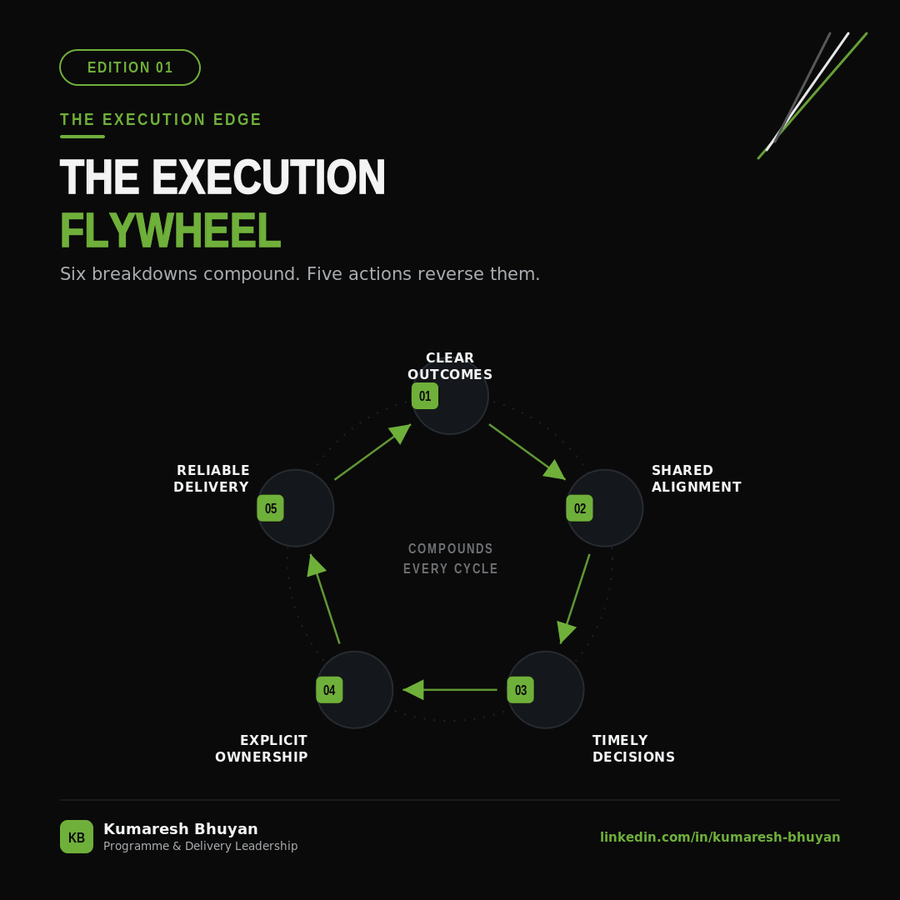
Six quiet breakdowns disconnect strategy from delivery, from feature-first backlogs to weaponized timelines, illustrated with real cases: Hertz vs. Accenture, Lidl's seven-year SAP migration, Healthcare.gov, TSB Bank. Decision velocity, not delivery velocity, is the real bottleneck.
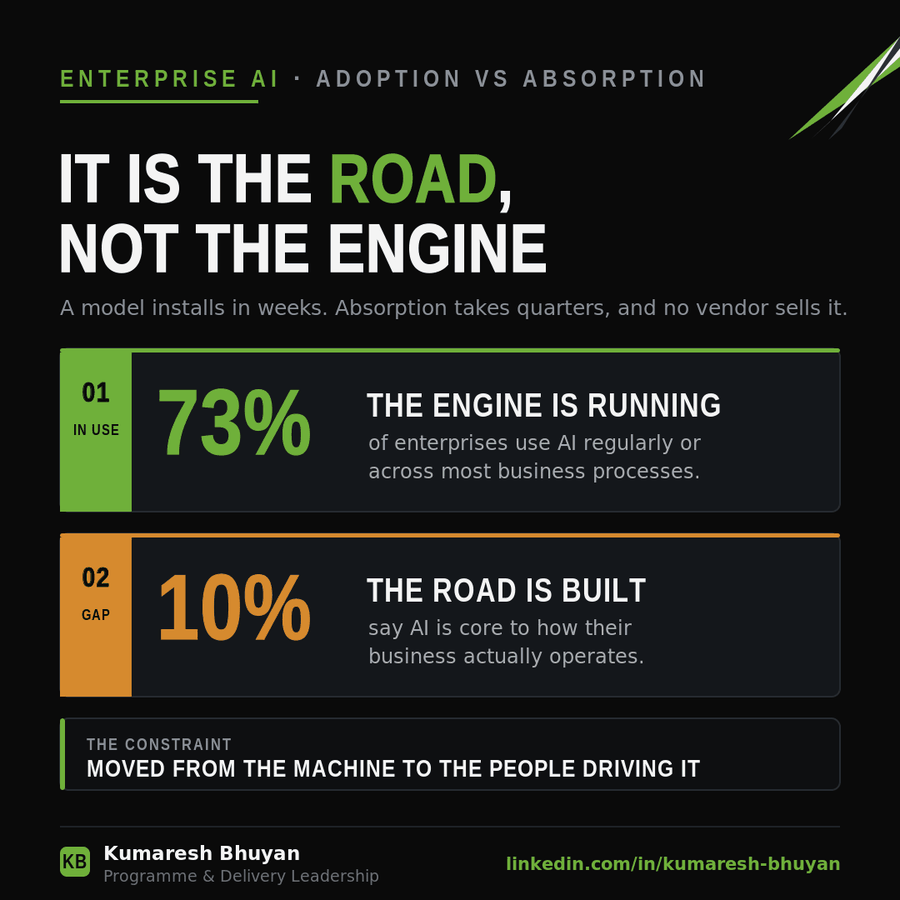
Vendor spending, a price war, a standards coalition, an adoption survey: four stories that together say the constraint has moved off the model and onto everything after it.
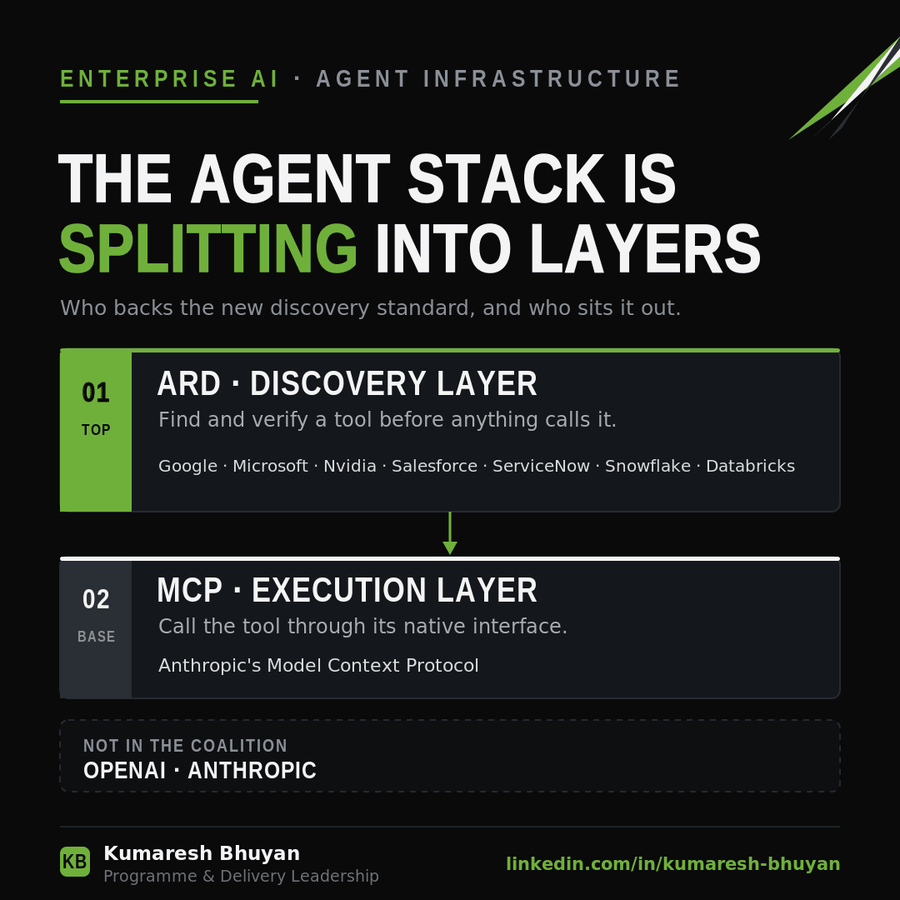
ARD sits above MCP: discovery versus execution. The interesting detail is who is not in the coalition, and why you should never bet a production stack on one vendor's protocol.
Audit rights in every contract, kill criteria agreed in advance, one named human per automated decision, everything logged. One page. No treaty required.
Twenty years of never trusting input, undone by assistants that believe everything they read. A real prompt-injection incident, and three questions for your team this week.
Microsoft, OpenAI and Anthropic are spending roughly eight billion dollars on deployment services. Nobody spends that on a solved problem. Production is where programmes stall.
Chinese-origin models now route more OpenRouter tokens than US models, at 60 to 90 percent lower cost. The spreadsheet says switch. Residency and defendability say slow down.
Global frameworks set a floor years away. These five controls protect your AI programmes this quarter. No treaty, no committee required.
Audit and evaluation rights go into every vendor contract before signing, so a model can be inspected, not just trusted.
Define the specific failure that pulls a model from production. Decide it calmly, well before any incident forces the call.
A single accountable owner for each automated decision. Accountability cannot sit with a system.
Everything the model did, and why, is recorded, so any outcome can be explained later, to a regulator or a customer.
The smallest, quietest failures get reviewed before the loud ones. That is where silent drift hides.
A designed, print-ready PDF of the checklist. Pin it to the wall, drop it in your next steering-committee deck, or send it to the team that owns your AI vendor contracts.
Download the checklistMore field notes like this are coming to my Substack. Follow along.
Super interested, really professional, and a keen observer. He always had a natural talent for team management. Super nice guy to work with.
Great at bringing the best out of people and creating great teams. To work from A to Z with precision and perfection, with a strong passion towards the product. This is what this person is best at.
Project Management Institute · 2023
Microsoft and LinkedIn · 2023
Siksha 'O' Anusandhan University · 2011 to 2015
Enterprise AI delivery, programme leadership, or a straight conversation about what adoption takes. The inbox is open.
Where I show up in other people's comment sections.
Field reactions from real threads, not polished takes. Topics only; the rest of each conversation stays where it happened.
"It was a workaround that became load-bearing. Added under deadline pressure, the two people who understood why it existed eventually left, and nobody wanted to remove it without knowing what would break. That's the failure mode I watch for now: not the big rewrite risk, the quiet fix that outlives everyone who could explain it."
"The harder problem isn't designing the platform, it's getting a team with a working pipeline to give it up. Nobody migrates off something that ships fine just because a shared alternative exists. Whoever owns the migration usually has to make the old way visibly more expensive first, then let the new one win on its own terms."
"The real failure mode is employees who stopped raising a concern because escalation changed nothing, not the AI's blind spot. Most reviews spend their time checking if the model is accurate, and almost none ask whether the intake process still reaches the person who saw the problem early."
"What's missing is a way to flag when the recommended scope conflicts with a date someone senior already promised outside the team. A structured starting point has nothing to say to the account lead who told a client yes three weeks ago."
"The detail that stands out: the same forecast that tells leaders to embed agents by 2026 also expects 40 percent of those projects cancelled by 2027. Boardrooms are hearing 'move now' and 'this mostly fails' from one source, and almost nobody says that part out loud before the budget gets approved."